Introduction
Every hospital in India runs its inpatient department on some version of the same question: how does information move reliably from the bedside to the doctor, from the nurse to the pharmacy, and from admission to discharge, without anything getting lost along the way. For decades, the answer was paper. Case sheets, nursing charts, medication registers, and consent forms travelled physically between wards, nursing stations, and the medical records department. That system worked, but it also created friction that most hospitals have simply learned to live with.
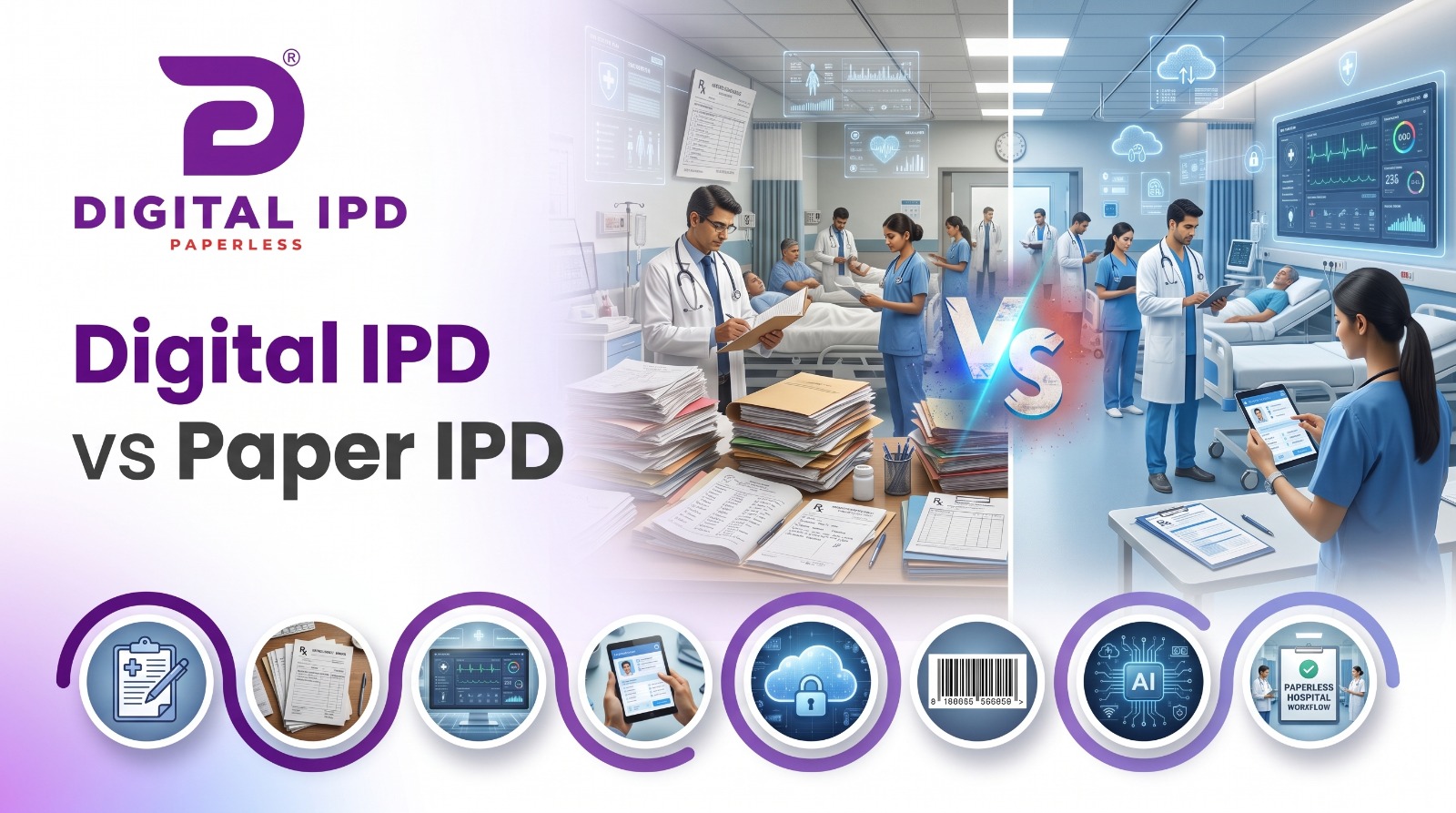
Digital IPD represents a different answer to the same question. Instead of information travelling on paper, it travels through a connected digital record that doctors, nurses, and administrators can access the moment they need it. This is not a debate about technology for its own sake. It is a practical comparison of two ways to run an inpatient department, and the choice affects everything from nursing time to discharge speed to how confidently a hospital walks into a NABH audit.
This article compares Digital IPD and traditional paper-based IPD across the areas that matter most to hospital owners, medical directors, nursing heads, and quality teams: documentation accuracy, coordination between departments, compliance readiness, cost, and the overall patient experience.
Understanding Traditional Paper-Based IPD
In a traditional paper-based IPD, every patient interaction generates a physical entry. Nurses record vitals on bedside charts. Doctors write progress notes into case sheets that sit in a file at the nursing station or move with the patient. Consent forms, medication administration records, and discharge summaries are filled out by hand and later compiled into a single physical file that eventually reaches the medical records department, or MRD.
This system has been the backbone of Indian hospital operations for a long time, and it is familiar to almost every clinician working today. Its strength is simplicity. A pen and a register require no training, no device, and no network connectivity. However, the same simplicity creates real operational strain as hospitals grow, patient volumes increase, and regulatory expectations around documentation become stricter.
Paper files can only be in one place at a time. When a doctor needs a case sheet that a nurse is currently updating, someone waits. When a file is misplaced between a ward transfer and a diagnostic department, valuable time is lost searching for it. Handwriting quality varies, which affects how easily other clinicians can read notes accurately. None of this reflects a lack of effort from hospital staff. It reflects the natural limitations of a physical, single-copy documentation system operating in a fast-moving inpatient environment.
Understanding Digital IPD
Digital IPD replaces the physical file with a connected digital record. Nurses capture vitals, medication administration, and bedside observations directly on a tablet or workstation. Doctors enter orders and progress notes into the same patient record, visible in real time to the rest of the care team. Consent forms, treatment updates, and discharge documentation are captured digitally from the point of care rather than being compiled later from scattered paper sources.
The shift is not simply about removing paper. It is about restructuring how information flows inside the hospital so that the same record is accessible to the right person at the right moment, whether that person is a nurse at the bedside, a doctor doing rounds, or an administrator preparing for an audit. Solutions such as Digital IPD are built around this central idea, and for hospitals, the experience improves through quicker admissions, more transparent billing, and discharge summaries that are accurate and instantly available.
Importantly, Digital IPD is generally positioned as a layer that strengthens inpatient documentation without requiring a hospital to replace its core hospital information system. This matters for Indian hospitals that have already invested significantly in an existing HIS and are looking to modernise the bedside experience specifically, rather than undertake a complete system overhaul.
Where the Two Systems Actually Differ
Speed of Information Access
In a paper-based IPD, information is only as fast as the person carrying it. A doctor reviewing a patient's history during rounds may need to wait for a file to be located, or work from an incomplete picture if the file has not yet been updated. In a digital system, the same information updates the moment it is entered and is visible immediately to anyone with authorised access, whether they are standing at the bedside or reviewing records from another part of the hospital.
Nursing Workload and Coordination
Nurses in a paper-based ward often spend a considerable part of their shift on documentation that could otherwise go toward direct patient care, simply because charting, cross-checking, and re-writing information across multiple registers takes time. Digital IPD is designed to reduce this duplication by capturing information once at the bedside and making it available across every relevant register automatically. Hospitals that have digitised OPD workflows such as appointments, prescriptions, billing, and lab orders often continue to struggle specifically with IPD digitisation, which is precisely where bedside documentation tools are designed to help.
Compliance and Audit Readiness
NABH does not mandate a specific documentation format, but it does require that documentation is complete, traceable, and retrievable. This is an important distinction. A well-maintained paper system can technically satisfy these requirements, but demonstrating completeness and traceability across hundreds of physical registers during an audit is a considerably harder task than retrieving a structured digital record. In a paper-based system, files get misplaced, forms are half filled, and when an audit arrives, valuable hours are lost hunting down specific records, with the infection control register in one place and medication charts elsewhere, making a unified review a genuine logistical challenge.
Discharge Readiness
Discharge is often the single most delayed step in the inpatient journey, largely because it depends on compiling information from multiple sources: the treating doctor's clearance, nursing summary, pharmacy reconciliation, and billing. When each of these lives on paper, compiling them into a final discharge summary takes time. When they live in a single connected digital record, discharge preparation can begin well before the final clearance, since most of the underlying information is already structured and complete.
Cost Over Time
Paper-based systems appear cheaper on the surface because there is no software cost. However, the ongoing cost of paper, printing, physical storage space, and staff time spent searching for or refiling documents accumulates steadily. Hospitals moving away from paper have documented administrative savings exceeding fifty percent compared to their earlier paper-based costs, alongside a meaningful reduction in paper consumption that also supports environmental goals.
Patient Experience and Safety Considerations
Patients and their families rarely see the back-end documentation process directly, but they experience its consequences. A delayed discharge because a file is incomplete, a repeated question from a nurse because the previous note was hard to read, or a billing discrepancy traced back to a missing entry all affect how a family experiences a hospital stay. Reducing these friction points through better documentation does not just improve operations. It improves trust.
From a safety standpoint, illegible handwriting, duplicate or missing entries, and delayed access to a patient's current medication list are recognised risk factors in inpatient care globally. Structured digital entry at the bedside reduces the chance of these errors by making fields mandatory, timestamps automatic, and records instantly visible to every relevant clinician rather than to whoever is holding the file at that moment.
Which Hospitals Should Consider Making the Shift
Not every hospital needs to digitise its entire inpatient department overnight, and a phased approach is usually more practical than a single large rollout. Mid-sized hospitals in Tier 1 and Tier 2 cities, particularly those working toward NABH accreditation or preparing for insurance and TPA audits, tend to see the clearest early benefits because IPD documentation is where the bulk of compliance risk and administrative cost is concentrated. Larger hospitals with an established HIS can also benefit by adding a bedside documentation layer specifically for IPD workflows, without disturbing systems that already work well for billing, pharmacy, or diagnostics.
Conclusion
The comparison between Digital IPD and traditional paper-based IPD is ultimately a comparison between two different relationships with information. Paper asks hospital staff to carry information physically and reconstruct a complete picture from scattered sources. Digital IPD asks the system to hold that complete picture continuously, updated at the bedside, and available the moment anyone on the care team needs it. For Indian hospitals under growing pressure to document more thoroughly, discharge patients faster, and walk into audits with confidence, this is not a marginal difference. It is a structural one, and it is increasingly becoming the standard that modern, well-run inpatient departments are expected to meet.
Frequently Asked Questions
Q1: What is the main difference between Digital IPD and traditional paper-based IPD?
Digital IPD captures nursing notes, doctor orders, vitals, and discharge documentation electronically at the bedside, while traditional IPD relies on handwritten registers and physical case sheet files that move manually between departments.
Q2: Is Digital IPD accepted for NABH accreditation?
NABH does not mandate a specific documentation format, but it does require records to be complete, traceable, and instantly retrievable, which digital systems are generally better positioned to demonstrate during an audit.
Q3: Does moving to Digital IPD disrupt existing hospital workflows?
A well-designed Digital IPD rollout is phased department by department and is built to fit around existing doctor and nursing routines rather than force an entirely new way of working on day one.
Q4: How much can a hospital save by going paperless in IPD?
Savings vary by hospital size and current paper dependency, but many mid-sized Indian hospitals report meaningful reductions in printing, storage, and administrative staff time within the first year of adoption.
Q5: Is Digital IPD only useful for large hospitals?
No, smaller and mid-sized hospitals with twenty to fifty beds often see faster relative gains because they can standardise documentation across the entire facility without disturbing a large existing HIS ecosystem.
Resources
- National Accreditation Board for Hospitals and Healthcare Providers (NABH): Accreditation standards and the sixth edition emphasis on digital patient records.
- Ministry of Health and Family Welfare (MoHFW), Government of India: National health policy and digital health guidelines.
- Ayushman Bharat Digital Mission (ABDM): Framework for interoperable digital health records in India.
- World Health Organisation (WHO): Global guidance on patient safety and clinical documentation standards.
Interlinking Keywords
Digital IPD, paperless IPD software, NABH compliant documentation, inpatient department digitisation, bedside documentation system, hospital discharge automation, IPD workflow management
Last medically reviewed by:
Clinical Documentation Advisory Team, Digital IPD on July 8, 2026
Medical Disclaimer:
This article is intended for informational and operational guidance purposes for hospital administrators and healthcare professionals. It does not constitute medical, legal, or regulatory advice. Hospitals should consult NABH guidelines directly and their own compliance and IT teams before implementing any documentation system.