How Cloud-Based Healthcare Systems Work
Healthcare is no longer limited to physical files, isolated hospital systems, or location-based patient records. Modern healthcare increasingly depends on digital infrastructure, and that shift has made cloud based healthcare one of the most important developments in the industry. From virtual consultations to instant access to patient records, healthcare organizations now rely on connected systems that can work across clinics, hospitals, laboratories, and even home devices. Understanding how these systems actually function matters not only for healthcare providers, but also for students, entrepreneurs, and businesses trying to understand where healthcare technology is heading.
Why Healthcare Needed a Different Kind of Digital Infrastructure
Traditional healthcare systems were built around physical storage and localized software. Hospitals often maintained their own servers, internal databases, and disconnected patient management systems. While this model worked for smaller operations in earlier decades, it struggled as healthcare became more data-driven.
A modern healthcare environment generates enormous amounts of information every day. Patient histories, diagnostic reports, scans, prescriptions, insurance records, and remote monitoring data all need to move quickly and securely between systems. Older infrastructure often created delays because information stayed locked within individual hospitals or clinics.
This is where cloud computing in healthcare started changing the system. Instead of storing information in isolated local servers, healthcare organizations began using centralized digital environments accessible through secure internet-based systems. This shift allowed hospitals, clinics, pharmacies, and specialists to work within a connected ecosystem rather than separate silos.
The importance of this transition becomes clearer in real-world scenarios. Consider a patient traveling internationally who suddenly requires emergency care. With older systems, accessing previous records would be difficult or impossible. In a cloud-enabled environment, authorized providers can securely retrieve patient history much faster, reducing delays and improving decision-making.
This is one of the major reasons why healthcare and cloud computing are now deeply connected. Healthcare systems increasingly require speed, flexibility, collaboration, and scalability, all of which cloud environments are designed to support.
Understanding How Cloud-Based Healthcare Systems Actually Work
At its core, a cloud-based healthcare system stores and processes healthcare information through internet-connected servers rather than local hardware installed inside a hospital. However, the real functionality goes far beyond online storage.
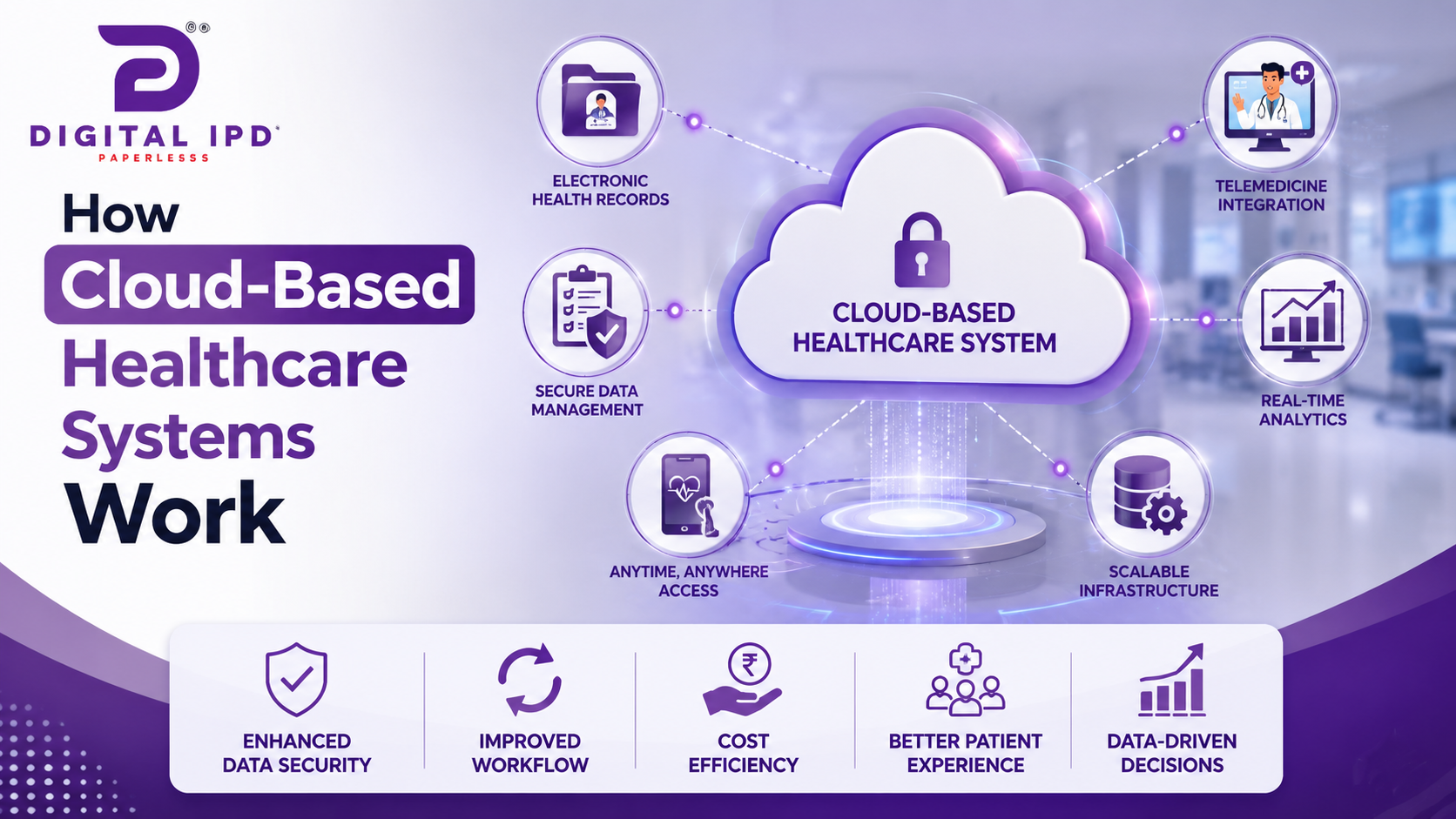
A cloud based healthcare software environment usually operates through multiple interconnected layers. Patient data is collected from clinics, diagnostic tools, wearable devices, or digital portals and then transmitted securely into centralized cloud systems. Authorized users can then access this data from different locations depending on permissions and system rules.
The process may seem simple from the outside, but several systems work together behind the scenes:
- Data synchronization allows healthcare teams to work from updated records in real timeWhen a doctor updates treatment notes or prescriptions, the information becomes instantly visible to other authorized professionals within the system. This reduces duplicate testing, communication delays, and administrative confusion across departments.
- Cloud security frameworks help protect sensitive patient information continuouslyHealthcare data is highly sensitive, which means cloud systems use encryption, access control layers, authentication systems, and monitoring protocols to reduce unauthorized access risks while maintaining accessibility for legitimate users.
- Scalable infrastructure helps systems manage sudden increases in demandDuring public health emergencies or large-scale healthcare events, cloud systems can process significantly higher data loads without requiring hospitals to physically upgrade their hardware infrastructure immediately.
- Remote accessibility changes how healthcare professionals interact with systemsDoctors, administrators, and specialists no longer need to remain inside a single hospital network to access important records. This flexibility has become increasingly important in remote consultations and distributed healthcare models.
This structure explains why cloud computing in the healthcare industry is not simply a technology trend. It fundamentally changes how healthcare operations function on a practical level.
How Cloud-Based Healthcare Changes Everyday Medical Operations
The real impact of cloud systems becomes visible in everyday workflows rather than technical architecture alone. In many healthcare environments, administrative delays historically created major operational inefficiencies. Appointment scheduling, patient registration, billing coordination, and medical reporting often existed in disconnected systems.
Modern cloud based medical software reduces these operational gaps by integrating multiple healthcare functions into unified digital environments.
For example, a patient booking an online appointment may simultaneously trigger schedule updates, billing workflows, medical record access preparation, and digital communication reminders. These automated interactions reduce manual work while improving patient experience.
This operational integration becomes even more valuable in larger healthcare networks where multiple facilities share responsibilities. Instead of each location functioning independently, cloud systems allow centralized coordination.
A cloud based medical practice software platform also helps smaller clinics compete more efficiently. Traditionally, advanced digital infrastructure required significant investment in physical servers and IT maintenance. Cloud systems lower those barriers by allowing smaller organizations to access enterprise-level digital tools without maintaining large internal infrastructure.
This has changed healthcare entrepreneurship significantly. Many startups now enter healthcare markets through software-driven models because cloud infrastructure reduces operational complexity and scalability limitations.
Why Cloud Systems Became Essential During Remote Healthcare Expansion
The rise of remote healthcare accelerated the importance of cloud systems globally. Telemedicine, remote diagnostics, and digital consultations require healthcare information to move securely between patients and providers regardless of physical location.
Without cloud environments, many remote healthcare services would become difficult to scale effectively.
This is particularly visible in situations involving chronic condition monitoring. Patients using wearable health devices generate continuous streams of information that need real-time analysis and storage. Cloud systems make this possible by handling large amounts of incoming data while allowing providers to monitor changes remotely.
Several practical patterns explain this shift:
- Patients increasingly expect healthcare accessibility similar to other digital servicesModern users are accustomed to real-time banking, shopping, and communication platforms. Healthcare systems are adapting to similar expectations regarding accessibility, scheduling, and information availability.
- Healthcare providers require operational flexibility across multiple environmentsPhysicians may work across clinics, hospitals, virtual consultation platforms, or remote care settings. Cloud systems support continuity across these environments more effectively than localized infrastructure.
- Healthcare organizations need faster collaboration between specialistsDigital imaging, test reports, and patient records can move between specialists more efficiently within cloud-based ecosystems, improving diagnostic coordination.
This explains why cloud computing in healthcare examples often focus heavily on telehealth and remote collaboration systems.
The Business and Operational Advantages of Cloud Healthcare Systems
Healthcare organizations adopt cloud systems for more than convenience. Financial sustainability, operational scalability, and long-term adaptability also play major roles.
Traditional infrastructure requires continuous hardware upgrades, maintenance teams, storage expansion, and system replacement cycles. Cloud environments shift much of this responsibility toward managed service structures, allowing healthcare organizations to focus more on care delivery rather than infrastructure management.
A cloud based medical practice management software environment can also improve operational visibility. Administrators can monitor workflows, patient movement, billing patterns, scheduling efficiency, and resource allocation more effectively through centralized dashboards.
Another important advantage involves disaster recovery. Healthcare systems cannot afford extended downtime because operational interruptions directly affect patient care. Cloud environments often include backup and redundancy systems that improve resilience during technical failures or unexpected disruptions.
This is one reason why cloud based healthcare continues expanding globally despite concerns regarding security and regulatory compliance.
Challenges and Limitations That Healthcare Organizations Still Face
Despite the benefits, cloud healthcare systems are not without challenges. One major concern involves balancing accessibility with privacy protection.
Healthcare information remains one of the most sensitive categories of digital data. Even with strong security frameworks, organizations must continuously manage risks related to cyberattacks, unauthorized access, and data misuse.
Another challenge involves integration complexity. Many hospitals still operate older legacy systems that were not originally designed for cloud compatibility. Transitioning these environments into modern cloud ecosystems often requires gradual migration strategies rather than immediate replacement.
Operational resistance can also slow adoption. Some healthcare professionals may initially struggle with workflow changes, especially in organizations transitioning from paper-heavy systems toward digital platforms.
Infrastructure inequality also creates limitations in some regions. Reliable cloud healthcare systems depend heavily on internet stability and digital accessibility, which can vary significantly depending on geography and infrastructure availability.
These challenges explain why healthcare and cloud computing require not only technical upgrades but also organizational adaptation and long-term planning.
How Cloud Healthcare Systems Will Continue Evolving
The future of healthcare technology increasingly points toward interconnected ecosystems rather than isolated applications.
Artificial intelligence, predictive analytics, remote diagnostics, wearable health monitoring, and automated administrative systems all depend heavily on scalable cloud environments. As healthcare becomes more personalized and data-driven, cloud infrastructure will likely become even more central to healthcare operations.
Future systems may increasingly focus on predictive care rather than reactive treatment alone. Instead of responding only after symptoms worsen, healthcare providers may use cloud-enabled monitoring systems to identify risk patterns earlier.
This shift also changes how healthcare businesses compete. Organizations that adapt effectively to cloud-driven infrastructure may improve efficiency, patient accessibility, and operational scalability faster than those relying heavily on traditional systems.
For students and entrepreneurs, understanding cloud computing in the healthcare industry is becoming increasingly important because healthcare technology roles continue expanding globally.
Conclusion
Understanding how cloud based healthcare systems work requires looking beyond digital storage alone. These systems reshape how healthcare organizations communicate, operate, scale, and deliver patient care. Through improved accessibility, operational integration, remote collaboration, and scalable infrastructure, cloud computing in healthcare has become a foundational part of modern healthcare systems.
As healthcare continues evolving toward connected and data-driven models, organizations, professionals, and businesses that understand healthcare and cloud computing will be better positioned to adapt to future healthcare demands and technological changes.
Frequently Asked Questions (FAQs)
1. How does cloud based healthcare improve patient data management?
Cloud based healthcare improves patient data management by storing records in centralized digital systems that authorized professionals can access securely from different locations. This reduces delays, improves coordination between departments, and supports better decision-making. It also strengthens the overall digital healthcare infrastructure by making healthcare information more connected and accessible.
2. Why is cloud computing in healthcare becoming more important?
The growth of cloud computing in healthcare is linked to the increasing demand for remote care, digital records, and scalable healthcare systems. Hospitals and clinics now handle large amounts of medical data daily, making cloud systems essential for faster access and better operational efficiency. This shift also supports the evolution of smart healthcare ecosystems.
3. What are some real cloud computing in healthcare examples?
Common cloud computing in healthcare examples include telemedicine platforms, digital patient portals, remote monitoring systems, and centralized hospital databases. These systems allow healthcare providers to access and share information more efficiently while improving patient communication and workflow management through connected healthcare technologies.
4. How does cloud based healthcare software support hospitals and clinics?
Cloud based healthcare software helps hospitals manage appointments, patient records, billing systems, and communication tools within a single platform. This improves operational efficiency and reduces manual administrative work. It also supports better healthcare data integration across multiple departments and facilities.
5. What is the difference between traditional healthcare systems and cloud based medical software?
Traditional systems often rely on local servers and isolated databases, while cloud based medical software stores information in internet-connected environments accessible from multiple locations. This creates better flexibility, faster updates, and improved collaboration between healthcare teams. It also allows healthcare systems to scale more efficiently as digital demands increase.
6. How does cloud based medical practice software help smaller healthcare businesses?
Cloud based medical practice software helps smaller clinics reduce infrastructure costs while gaining access to advanced digital tools. Instead of maintaining expensive servers, clinics can use cloud platforms for scheduling, patient records, and billing. This supports more efficient practice management workflows and improves operational flexibility.
7. Is cloud computing in the healthcare industry secure enough for patient records?
Security remains one of the biggest priorities in cloud computing in the healthcare industry. Modern cloud systems use encryption, access controls, and authentication protocols to help protect sensitive patient information. At the same time, healthcare organizations must continuously update security strategies to support safe and reliable healthcare cybersecurity practices.
8. How do cloud systems support remote healthcare and telemedicine?
Cloud systems allow healthcare professionals to access records, communicate with patients, and manage consultations remotely. This makes telemedicine more practical and scalable. By supporting real-time information sharing, healthcare and cloud computing together improve accessibility for patients who may not always visit healthcare facilities physically.
9. What challenges do healthcare providers face when moving to cloud systems?
Healthcare providers often face challenges such as system migration complexity, staff training, and data security concerns during cloud adoption. Older legacy systems may also require gradual integration. These transitions are part of the broader shift toward modern healthcare technology infrastructure and digital healthcare transformation.
10. Why do entrepreneurs and students need to understand cloud based healthcare systems?
Understanding cloud based healthcare is becoming increasingly important because healthcare technology continues expanding globally. Students exploring healthcare careers and entrepreneurs building digital health solutions benefit from understanding how cloud systems improve scalability, operational efficiency, and patient accessibility within evolving healthcare innovation environments.