IPD Software vs Traditional Hospital Management
Healthcare systems are evolving faster than ever, yet many hospitals still struggle with fragmented workflows, delayed patient records, and inefficient coordination between departments. This is where the conversation around opd vs ipd systems becomes more important. Modern IPD software is no longer just a digital replacement for paperwork. It has become a central operational framework that influences patient care, billing, communication, and decision-making. Understanding how digital IPD systems compare with traditional hospital management is essential for healthcare businesses, administrators, and entrepreneurs looking to build future-ready healthcare operations.
Understanding OPD and IPD in Modern Healthcare Systems
Before comparing software systems, it is important to understand the operational difference between OPD and IPD environments. The opd ipd full form stands for Outpatient Department and Inpatient Department. OPD refers to patients who visit hospitals for consultations or treatments without admission, while IPD involves patients admitted for ongoing monitoring, treatment, or procedures.
In traditional hospital setups, OPD and IPD operations often function independently with separate documentation processes, disconnected communication channels, and manual coordination. This structure may work in smaller facilities, but as patient volume increases, inefficiencies begin to appear.
The distinction between ipd and opd becomes operationally critical when patient records, diagnostics, pharmacy, room allocation, and billing need to work together in real time. Modern IPD software bridges these processes by creating centralized access to patient data and workflow tracking.
This shift matters because healthcare today is no longer limited to treatment alone. Hospitals are expected to deliver faster coordination, improved transparency, and smoother patient experiences. The old model of physically transferring files between departments often slows down care delivery and increases administrative workload.
Understanding the ipd opd meaning is therefore not just about definitions. It is about recognizing how hospital operations behave under real-world pressure when systems are either connected or disconnected.
How Traditional Hospital Management Functions in Real-Life Scenarios
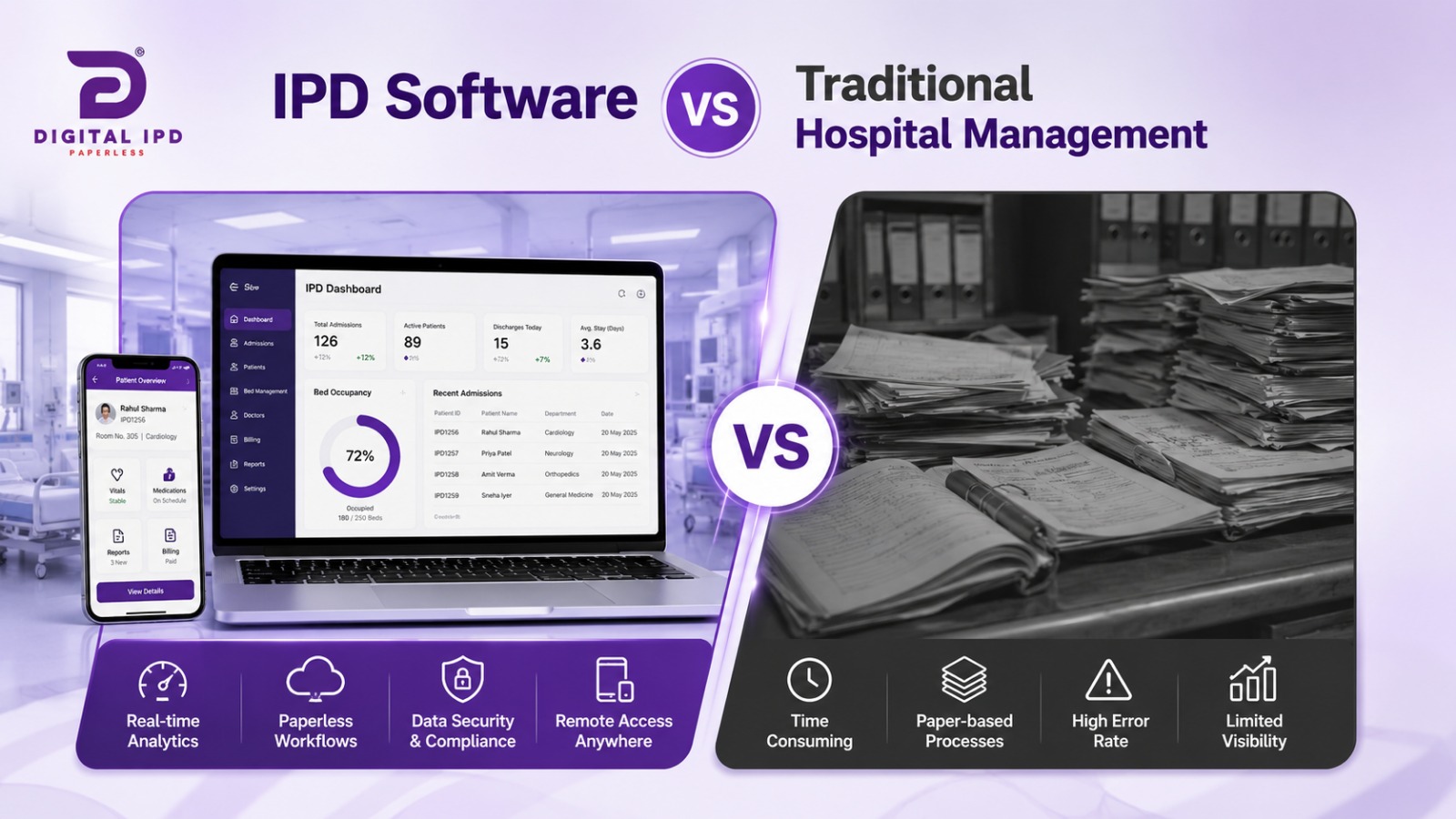
Traditional hospital management relies heavily on manual coordination. Patient records are often maintained physically or across disconnected software systems. While this method has been used for decades, its limitations become visible when hospitals handle increasing patient loads and complex treatment pathways.
In many hospitals, a patient entering through OPD may later require admission into IPD. In traditional systems, this transition often involves repeated paperwork, duplicated records, and communication gaps between departments. Even small delays can affect patient satisfaction and operational efficiency.
The challenges become more noticeable in scenarios involving emergency admissions, specialist referrals, or long-term inpatient care. Staff members spend considerable time locating records, confirming prescriptions, updating billing information, and coordinating with laboratories.
Common Operational Gaps in Traditional Systems
- Patient information often moves slower than the patient itselfIn traditional workflows, physical files or manually updated records can create delays between departments. This becomes problematic when quick decisions are needed, especially during emergency admissions or sudden treatment escalations.
- Administrative dependence increases workload pressureNurses, reception teams, and billing staff frequently spend more time handling documentation than patient interaction. This operational imbalance affects efficiency and contributes to staff fatigue.
- Errors become more likely during repeated manual entryDuplicate data entry across departments increases the possibility of inconsistencies in records, prescriptions, and billing details. Small inaccuracies can eventually create larger workflow complications.
These issues explain why hospitals are increasingly re-evaluating the balance between traditional systems and digital infrastructure.
Why IPD Software Is Changing Hospital Operations
Modern IPD software does more than digitize records. It restructures how hospitals function internally. Instead of departments working in isolation, software-driven systems create connected workflows where information moves instantly between teams.
The difference between ipd vs opd management becomes more visible in software-based environments because inpatient care requires continuous monitoring, coordinated treatment updates, and integrated billing. IPD software centralizes these activities into a single operational system.
For example, when a patient is admitted, doctors, nurses, pharmacy teams, diagnostic labs, and billing departments can all access synchronized information. This reduces delays and minimizes repeated administrative tasks.
Another major advantage is workflow visibility. Hospital administrators can monitor occupancy rates, patient movement, discharge timelines, and treatment coordination in real time. Traditional systems rarely offer this level of operational insight without significant manual reporting.
The rise of digital healthcare expectations has also influenced patient behavior. Patients now expect appointment updates, digital records, faster billing, and smoother communication. Hospitals using outdated systems often struggle to meet these expectations consistently.
This transformation explains why IPD software is becoming essential not only for large hospitals but also for growing healthcare facilities aiming to scale operations effectively.
The Operational Difference Between OPD and IPD Software Workflows
The comparison of opd ipd systems becomes clearer when observing daily hospital workflows.
OPD management focuses on appointment handling, consultation records, prescriptions, and follow-ups. The process is relatively shorter because patients are not admitted for long-term monitoring.
IPD workflows, however, involve significantly more coordination. Admitted patients require room management, nursing records, medication tracking, diagnostics, surgical scheduling, discharge planning, and continuous documentation.
Traditional systems manage these tasks through separate teams and physical coordination. IPD software connects them digitally, reducing friction between departments.
How Software Improves IPD Coordination
- Centralized records improve treatment continuityDoctors and nurses can instantly access patient history, medication details, and test reports without waiting for physical files. This improves decision-making speed and treatment accuracy.
- Billing and treatment updates stay synchronizedIn traditional systems, billing discrepancies often occur because departments update records separately. IPD software keeps financial and clinical data connected in real time.
- Discharge planning becomes more efficientDelays in discharge often happen because departments clear processes sequentially. Digital systems streamline approvals and reduce unnecessary waiting periods for patients.
These improvements directly influence patient satisfaction and operational performance.
Why Healthcare Businesses Are Moving Toward Smart Hospital Infrastructure
Hospitals today operate within a highly competitive healthcare environment. Efficiency is no longer just an internal goal. It affects reputation, patient trust, scalability, and long-term sustainability.
Entrepreneurs and healthcare businesses exploring digital transformation often begin by evaluating how ipd & opd operations impact overall workflow efficiency. Manual systems may appear manageable initially, but they become difficult to scale as patient numbers grow.
Modern IPD software provides measurable operational advantages. It reduces administrative dependency, improves reporting accuracy, and allows leadership teams to identify bottlenecks quickly.
There is also a financial perspective behind this transition. Traditional inefficiencies often lead to delayed billing, underutilized resources, and avoidable operational costs. Software-driven systems help optimize resource allocation and improve workflow visibility.
This shift reflects a broader trend in healthcare management. Hospitals are moving from reactive operations toward predictive and data-informed systems that support long-term planning.
Real-World Situations Where Traditional Systems Still Struggle
Despite technological progress, many healthcare facilities continue operating with hybrid or fully manual systems. The reasons vary from budget limitations to resistance toward digital adoption.
However, real-world operational stress often exposes the weaknesses of traditional management structures.
For instance, during seasonal patient surges or public health emergencies, disconnected systems create delays in admissions, diagnostics, and room allocation. Staff members spend valuable time coordinating manually instead of focusing on patient care.
Another common issue appears during interdepartmental communication. In traditional systems, information gaps between nursing stations, laboratories, and billing teams can slow down treatment cycles.
The comparison of ipd vs opd workflows becomes especially important in such situations because inpatient operations involve continuous coordination across multiple departments simultaneously.
These operational realities explain why many hospitals are prioritizing digital infrastructure despite implementation challenges.
Challenges Hospitals Face While Adopting IPD Software
Although IPD software offers clear advantages, implementation is not always simple. Transitioning from traditional systems requires operational adjustment, staff training, and infrastructure planning.
One challenge is resistance to workflow change. Hospital teams accustomed to manual systems may initially find digital processes unfamiliar. Without proper onboarding, adoption can feel disruptive rather than helpful.
Data migration is another concern. Converting years of physical or fragmented records into a centralized system requires careful planning and verification.
Smaller healthcare facilities may also worry about implementation costs. However, many organizations eventually recognize that operational inefficiencies often cost more over time than digital transition itself.
The important factor is not simply adopting software but choosing systems aligned with hospital size, workflow complexity, and long-term goals.
The Future of Hospital Management Is Integrated, Not Isolated
The future of healthcare operations lies in connected systems rather than isolated departments. Hospitals are increasingly moving toward integrated ecosystems where OPD, IPD, diagnostics, pharmacy, billing, and patient communication function together seamlessly.
Understanding the operational meaning behind opd ipd meaning is therefore becoming more relevant for healthcare businesses and decision-makers. It is not only about managing patients efficiently but also about building scalable healthcare systems that adapt to growing expectations.
As healthcare becomes more data-driven and patient-focused, traditional management methods are likely to struggle with speed, transparency, and operational flexibility.
IPD software represents a shift toward proactive healthcare management where systems support coordination instead of slowing it down.
Conclusion
The comparison between IPD software and traditional hospital management highlights more than just technological change. It reflects a broader transformation in how healthcare systems operate, communicate, and scale. Understanding opd vs ipd workflows and the operational role of connected systems helps hospitals improve efficiency, patient experience, and long-term sustainability.
As healthcare expectations continue evolving, digital IPD systems are becoming less of an upgrade and more of a foundational requirement for modern hospital operations.
Frequently Asked Questions (FAQs)
1. What is the main difference between IPD software and traditional hospital management?
The biggest difference lies in workflow integration and operational visibility. Traditional systems often depend on manual coordination, while modern IPD software connects departments through centralized digital processes. This improves hospital workflow management and supports better patient data coordination across multiple departments.
2. Why are hospitals shifting from manual systems to digital IPD software?
Hospitals are moving toward digital systems because manual operations become difficult to manage as patient volume grows. IPD software improves efficiency, reduces administrative delays, and supports smart healthcare infrastructure through real-time access to records and operational updates.
3. How does IPD software improve patient management in hospitals?
IPD software helps hospitals track admissions, room allocation, medication updates, diagnostics, and billing within one connected system. This improves inpatient workflow optimization and creates a smoother experience for both staff and patients.
4. What role does OPD play in a hospital management system?
OPD focuses on outpatient consultations, appointments, and follow-ups, while IPD handles admitted patients requiring continuous care. Understanding the relationship between these systems helps improve digital healthcare coordination and ensures better communication across departments.
5. Is IPD software suitable only for large hospitals?
No, even smaller healthcare facilities benefit from IPD systems. As patient records and operational demands increase, software-driven systems help maintain organized workflows. This supports scalable healthcare operations and reduces dependency on manual administration.
6. How does digital hospital management reduce operational errors?
Digital systems reduce repeated manual entry and disconnected reporting processes. By centralizing information, hospitals improve clinical workflow efficiency and minimize documentation inconsistencies between departments.
7. What challenges do hospitals face while implementing IPD software?
Hospitals often face staff adaptation issues, data migration concerns, and infrastructure planning challenges. However, with proper onboarding and planning, these systems improve integrated hospital operations and long-term workflow management.
8. Can IPD software improve hospital billing and financial tracking?
Yes, IPD systems synchronize clinical updates with billing records in real time. This reduces financial discrepancies and improves healthcare resource management, especially in hospitals handling large inpatient volumes.
9. Why is workflow visibility important in modern hospitals?
Workflow visibility helps administrators monitor occupancy, discharge timelines, and treatment coordination instantly. This supports hospital process automation and allows faster operational decision-making during high patient activity.
10. What is the future of hospital management systems?
The future of hospital management is centered around connected digital ecosystems where OPD, IPD, diagnostics, and billing work together seamlessly. This shift supports patient-centric healthcare systems and improves long-term operational adaptability in modern healthcare environments.