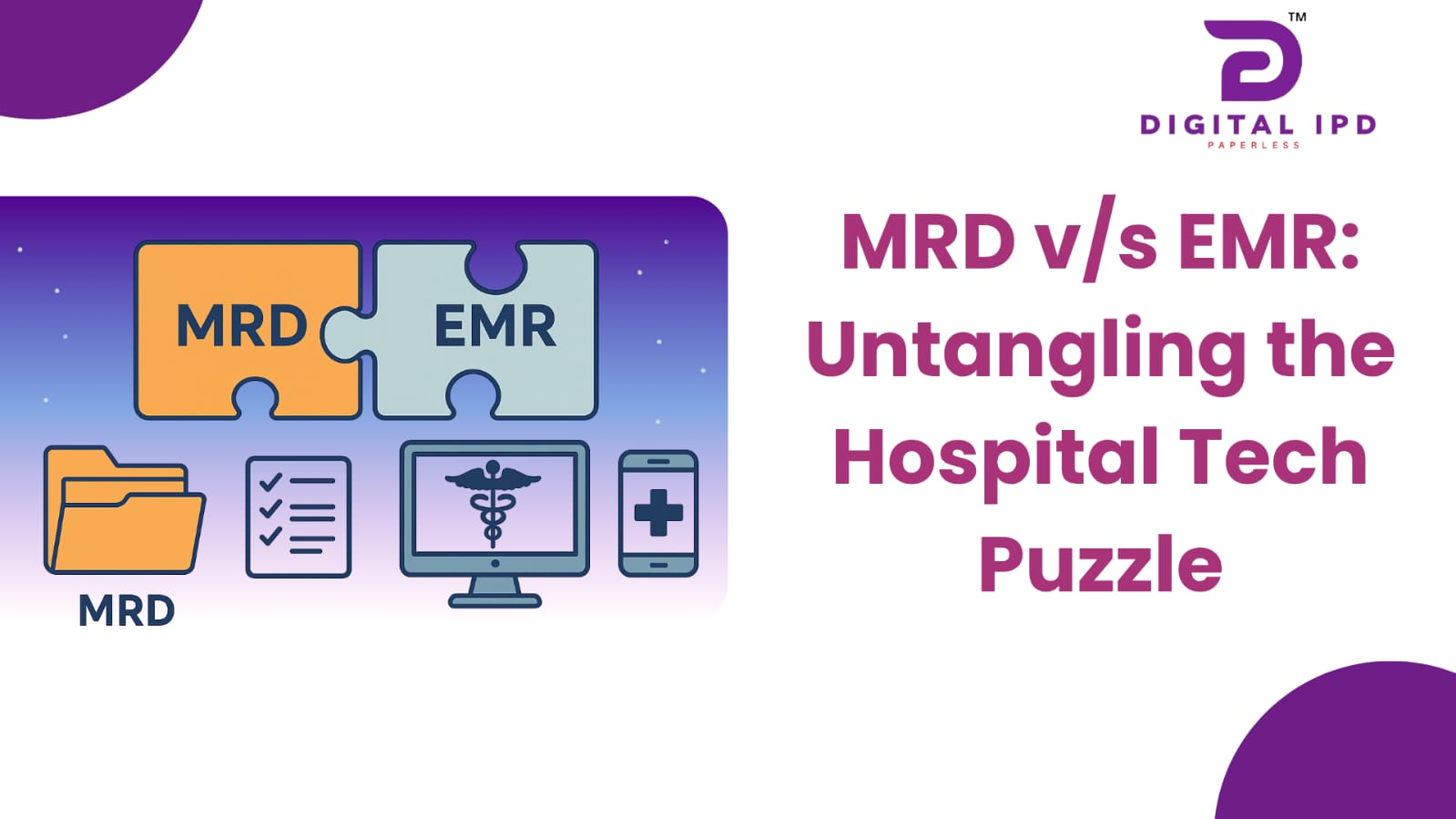
Ever feel like hospital technology comes with its own confusing language ? Terms like EMR and MRD get tossed around, often leaving hospital administrators and doctors scratching their heads. Aren't they basically the same thing ? you might wonder. Well not quite, understanding the difference between Medical Record Department (MRD) Software and Electronic Medical Record (EMR) systems is not just tech jargon, it is about choosing the right tool to make your hospital run smoother and care better, especially for those crucial inpatient stays. Let us break it down, simply.
Setting the stage:
Imagine a hospital as a bustling city. Patient information is its lifeblood, flowing everywhere.
- EMR (Electronic Medical Record):
Think of this as the city's central archive and activity log. It is the comprehensive digital version of a patient's entire medical history within one hospital or clinic network. Doctor's notes from OPD visits, diagnoses, medication lists, allergies, vaccination records, lab results, imaging reports, it all lives here. It is the broad view, the longitudinal story of a patient's interactions with that specific healthcare facility.
- MRD software:
Now, picture the dedicated team managing the physical and digital records specifically for patients admitted to the hospital, the Inpatient Department (IPD). MRD Software ( Digital Ipd ) is the specialized tool designed for and by the Medical Records Department. Its core mission ? To efficiently manage the complete inpatient record lifecycle, from the moment a patient is admitted until long after they are discharged. It focuses intensely on the IPD workflow.
So, What is the real difference ? It is all about focus and function
While both deal with patient records, their purposes and strengths diverge significantly:
Feature
MRD software
EMR System
Core focus
Inpatient (IPD) record lifecycle management
Comprehensive patient medical history across all departments
Primary function
Managing complete IPD records, coding, billing, retrieval
Clinical documentation at point of care
Key users
MRD staff, coders, billers
Doctors, nurses, clinicians
Workflow specialty
Post discharge processing, coding, record completion
Real time clinical documentation during care
Critical role
Ensures accurate billing and compliance
Supports clinical decision making during treatment
The depth of inpatient journey: An EMR captures clinical data as it happens during the IPD stay, doctor's progress notes, nursing charts, medication administration records. MRD Software however, takes the baton after discharge. It ensures the entire IPD record, every single page, every test result, every note is complete, organized, audited, coded accurately using ICD codes and ready for billing and permanent archiving. It manages the sheer volume and complexity of the complete inpatient file.
The workflow masters: MRD Software is built specifically for the high pressure, detail oriented world of the Medical Records Department. It streamlines:
- Tracking record completion: Chasing down doctors for missing signatures or pending reports ? MRD software automates reminders and tracks completion status meticulously.
- Coding and billing accuracy: Accurate medical coding translating diagnoses and procedures into universal codes is vital for correct billing and insurance claims. MRD software provides specialized tools and workflows to support coders, reducing errors and denials.
- Efficient retrieval: When a patient returns or an audit happens, finding that specific IPD record from years ago needs to be fast. MRD software indexes records brilliantly for quick retrieval, whether physically or digitally.
- Compliance and audit trails: Maintaining strict records of who accessed what and when is critical for legal and regulatory compliance like NABH in India. MRD software enforces this rigorously.
Clinician's tool v/s Administrator's ally:
Doctors and nurses primarily use the EMR at the bedside for real time care. The MRD team relies on MRD software to manage the final, legal record efficiently behind the scenes. It is their command center for productivity and accuracy in the back office.
Why does this distinction matter ? Your hospital's health depends on it. Choosing the right system ( Digital Ipd ) is not about picking one over the other hospitals often need both. It is about understanding their unique roles and ensuring they work together seamlessly. Getting it wrong has real consequences:
- Billing blues and revenue leakage: Inaccurate or delayed coding due to poor MRD processes directly hits the hospital's bottom line. Claims get rejected, payments are delayed, revenue is lost. Robust MRD software is your financial safeguard.
- The audit anxiety: NABH or other regulatory audits require impeccable, complete and retrievable records. Manually chasing incomplete files or struggling to find records during an audit is a nightmare. MRD software brings order and confidence.
- Doctor frustration and delays: When MRD staff constantly chase doctors for missing signatures or reports via phone or email, it interrupts clinical workflow. Efficient MRD software automates this communication, freeing up valuable time for both sides.
- Patient care impact: Believe it or not, efficient MRD matters for future care. Complete, accurately coded records ensure when a patient returns, their full history is readily available. Slow retrieval delays treatment decisions.
- Operational gridlock: Without dedicated MRD software, the department drowns in paper or disorganized digital files, processes slow down, backlogs build and staff morale plummets. Efficiency vanishes.
The Digital IPD connection:
This is where understanding platforms like Digital Ipd becomes crucial. While comprehensive EMRs handle the breadth of patient data, solutions like Digital IPD often emphasize enhancing the inpatient experience and streamlining IPD specific operations. They might integrate with your EMR and MRD systems, focusing on:
- Real time patient updates: Reducing anxious calls to the MRD or nursing station.
- IPD billing transparency: Giving patients clear, upfront estimates and daily bills.
- Centralized IPD communication: Streamlining requests between patients, nurses and admin.
- Efficient discharge processes: Ensuring smoother transitions and faster final bill preparation.
The takeaway:
Think of your EMR as the detailed storybook of the patient's health journey within your walls. Think of your MRD Software as the meticulous librarian and archivist who ensures that story especially the critical inpatient chapters is complete, correctly catalogued, readily available and financially accounted for.
For Indian hospitals aiming for operational excellence, financial stability and compliance peace of mind, investing in dedicated, specialized MRD Software is not optional; it is essential. It complements the clinical power of the EMR by ensuring the vital backend processes; coding, billing, record completion and retrieval run with precision and efficiency. When your MRD department thrives with the right tools, your entire hospital runs better, bills accurately, stays compliant and ultimately, frees up more energy and resources for what truly matters: patient care. Is it not time your hospital records worked smarter, not harder ?